I’m looking at one of the most remarkable sessions we’ve run at Ultraspeaking.
Back in January, Santosh, one of our OG coaches, gave a masterclass in storytelling.
But before I tell you about that, I need to tell you more about why our students go to Santosh with storytelling questions.
Santosh didn’t start as a coach. A few years ago, he was right where you are now, reading and learning about how to be a more effective communicator.
Santosh picked up the book Ultralearning by Scott Young. There’s a chapter about how I went from anxious to a finalist in the world championship of public speaking in just seven months.
He decided to sign up to one of our cohorts and never stopped. Fast forward to now, he has coached his 100th cohort.
So I want to share the storytelling framework most of our students go to him to learn.
Why your data isn’t moving the room
In one of Santosh’s sessions, a founder named Yan asked for help prepping for his next company meeting. “How much should I lean on personal stories, and how do I choose which ones to use?”
Santosh has coached many people who wondered about some version of that. And I’m sure this will hit home for you.
Imagine you’re in a meeting where you have to propose a solution to your peers.
You bring in the data, the logic, and the projected impact. It all sounds pretty solid.
At the end of it, your point of view barely moves any decision forward, and nothing gets done.
Meanwhile, there’s another colleague with half your evidence who gets the green light.
You’re left wondering, “How’s what they said more solid than my version? I brought numbers.”
When it comes to influencing and getting buy-in, most people lean too hard on the evidence or data, and too little on bringing the data to life. That is true whether you’re trying to get buy-in from a tricky stakeholder, presenting to colleagues, giving a talk, selling a solution to a client, or joining a podcast or panel as a guest.
No matter how much you explain your ideas or back them up with data, Santosh always says, “Stories make people feel something. They act on what they feel, not on what they understand.”
For Santosh, stories bypass your mental filter. “We have been wired for thousands and thousands of years to listen to stories,” so the brain leans in, the guard drops, and the message gets through.
That’s why when people speak with an airtight pitch, presentation, or script, it sounds robotic.
Information usually reaches the part of us that weighs the facts. But it rarely impacts our decisions.
Facts versus a story
Santosh used a brilliant example to illustrate the difference between stating facts to sell your ideas and telling stories.
Let’s say you’re an operations manager at a logistics company, and you need to pitch a change to colleagues and your boss: “We should invest in automation tools. It’ll reduce time by 30%.”
It’s probably accurate, beneficial, logical, and also forgettable.
If you bake in a story: “Last quarter, Emilie spent every weekend manually fixing errors. She would wake up in the morning at 5am before her kids got up so she would have time to do it. An automation could do this in seconds. Let’s give Emilie her weekends back.”
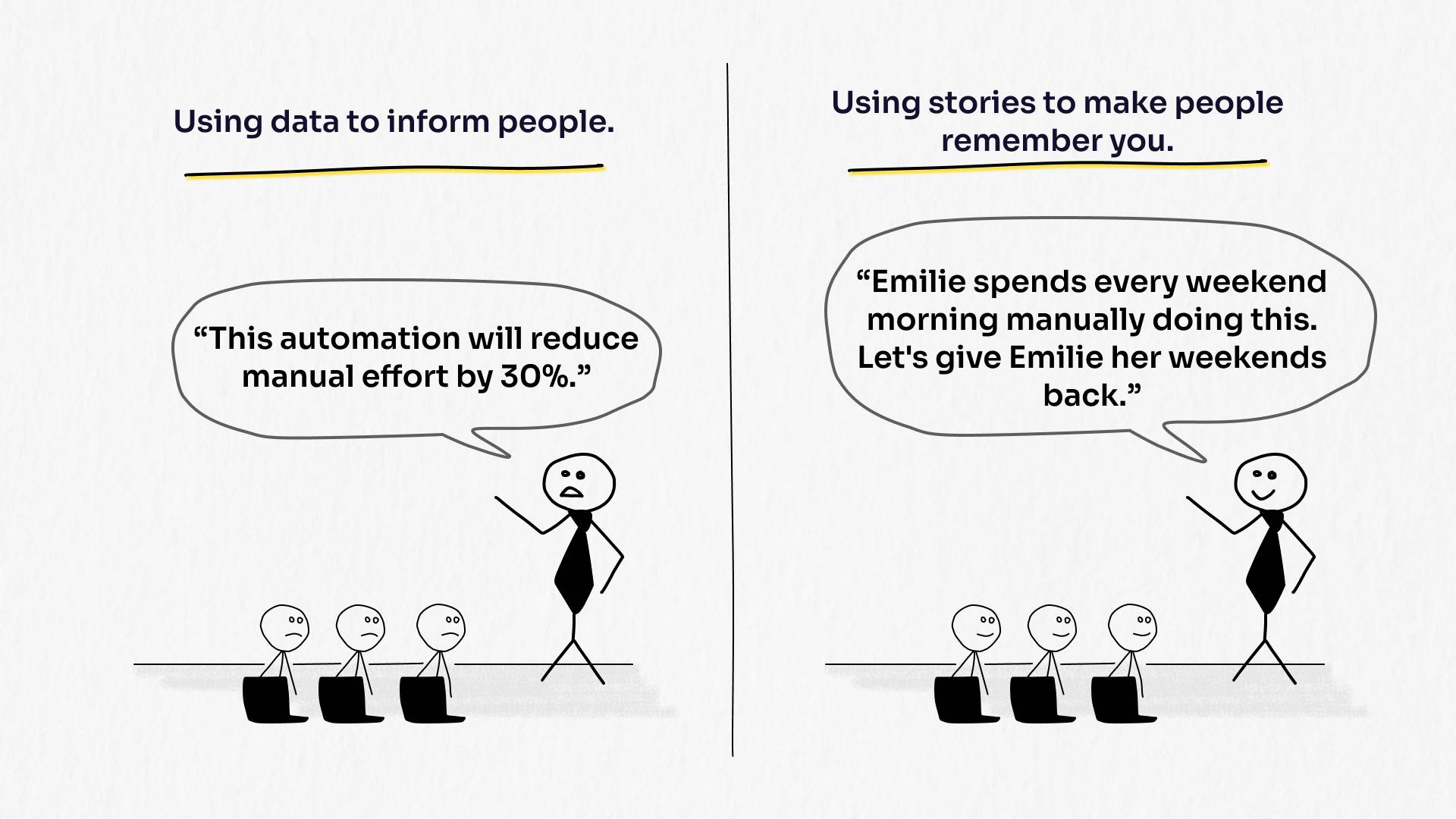
The second version has more impact because it uses “emotion with evidence,” according to Santosh.
It gives the room someone to picture: a teammate spending her Saturday fixing errors by hand is something the colleagues can feel too. It makes the cost feel like theirs, because probably everyone in that meeting has lost a weekend to a problem at work, and once they’ve felt that, you’re not the only person in the room arguing for the change. And it gives them something to want. “Let’s give Emilie her weekends back” is a sentence people say yes to.
One of the best ways to apply emotion with evidence is by using Santosh’s scaffolding framework.
The 3 P’s: Problem, Possibility, Proof

1. Problem: make the pain specific and human
Before your presentation or talk, show the gap that exists before your idea.
But be specific. A specific problem gives them someone to picture. And the more you can humanize it, the better.
Let’s use another example Santosh shared with Yan: “Our support team spends five hours a day answering the same questions again and again.”
This is something anyone can relate to, applied to their own work. Almost everyone spends time on repeated tasks.
2. Possibility: paint a better future they can believe in
For some people, painting a better future feels forced. Yan said, “It should naturally come out. Not a mechanical tone.”
Following our example: “Our support team spends five hours a day answering the same questions again and again. Imagine if customers could find those answers instantly.”
I can see how it comes across as forced. It reads like a commercial.
But Santosh proposed a solution to this. And it’s something we practice and preach over and over at Ultraspeaking.
Before you go out in the real world to present your possibility, run it enough times out loud. Practice with other people first, so that when you go for the presentation or talk, it sounds like you and not a scripted slide.
Repetition in low-stakes situations is what helps you sound natural in the big moments.
3. Proof: anchor the future with one win or early result
When you’re presenting an idea, you can use numbers or data to move the room.
But it’s more effective if you pair it with the problem and possibility. People care about the solution if they care about the problem first.
When you paint the future, it sounds like a promise. If you bring some proof, it turns it into something the people listening to you can trust.
In Santosh’s example, proof sounds like this: “Our support team spends five hours a day answering repeated calls. Imagine if customers could find those answers instantly. We tried it in one region, and calls dropped 40%.”
Proof paired with a story is how the data comes to life. It’s what makes people think “that makes sense” and it’s what makes them feel “I resonate so much with this.”
A structure, not a script
This framework works as a structure, not a script.
At the end of the session, Yan said something I want you to leave with today. “Frameworks give you enough security, but then you’re able to play with them. That’s what makes it authentic and easy to remember.”
In your next meeting, try it out. Modify it, test enough times to sound like you.
Take something you need people to agree to, and run it out loud.
You can’t build this on paper, though. It clicks when you say it out loud, with other people. Somewhere low-stakes enough to experiment.
Which is exactly what a free class is for. You get on a live call with a coach and a small group, you practice in short, low-pressure rounds, and you leave with something you can use the same day.
See upcoming free live classes
Santosh has helped hundreds of professionals who walked in nervous and walked out able to make a room feel something. He has a gift for storytelling, and he gives it away every week in our cohorts and free classes.

To 100 more, Santosh.
Tristan
Common questions about storytelling at work
Won’t telling stories in a business meeting seem unprofessional?
Not if the story carries the evidence. “Let’s give Emilie her weekends back” contains the same fact as “30% less manual effort,” it just gives the room someone to picture. People decide on what they feel, then justify it with what they understand. A story that stays specific, short and true to your point is the most professional thing in the room, because it is the one thing people will remember.
How do I keep the “possibility” part from sounding like a sales pitch?
Say it out loud, with other people, enough times that it stops being a line and starts being something you mean. The commercial tone comes from reading a sentence you haven’t lived with yet. It goes away when the words are yours. A framework gives you the shape; the practice gives you the voice.
Which stories should I use?
The specific, human ones that already sit inside your work: the teammate who lost a weekend, the region where the calls dropped. You don’t need to invent anything or reach for a dramatic anecdote. Look for the moment that made you care about the problem in the first place. If it moved you, it will move them.