You know the feeling when you’re almost at the end of your train of thought, you take a second to pause to find some clarity, and then someone jumps in.
“Actually, I think that…”
And before you can get back to your sentence, the conversation goes in another direction.
Even if you manage to get back on track, you fear someone might interrupt you again and again.
I want to share a story and a way of thinking about it that helps with that fear.
Anna’s question
A few weeks ago, coach Aman ran a workshop with 100 Women in Finance.
There were a few hundred people on Zoom, almost all of them in roles where meetings move fast and the room doesn’t slow down for anyone.
One of the attendees asked a question that turned into a mini coaching session.
Anna was struggling with interruptions in high-stakes meetings.
She told us that every time she’s presenting or in a meeting, she wants to pause to regain clarity over what she wants to say.
At Ultraspeaking, we teach pausing to give your brain a moment to catch up to itself and find the clearest version of what you want to say next. As a bonus, it helps the audience catch up to you.
But for Anna, pausing made her afraid of someone jumping in and interrupting her. As a result, she just couldn’t bring herself to pause.
“In a perfect world, I would love to bring more pauses in. But at work, if I do that, people are just going to interrupt me. And then I can’t finish my train of thought.”
Pausing is not the problem
This is one of the most common fears we hear, and almost everyone thinks pausing is the problem.
When you pause mid-talk, you’re so afraid someone steals the floor that you cut it out and speak faster to stay ahead of them.
But the problem is the story that runs in your head the moment someone cuts you off.
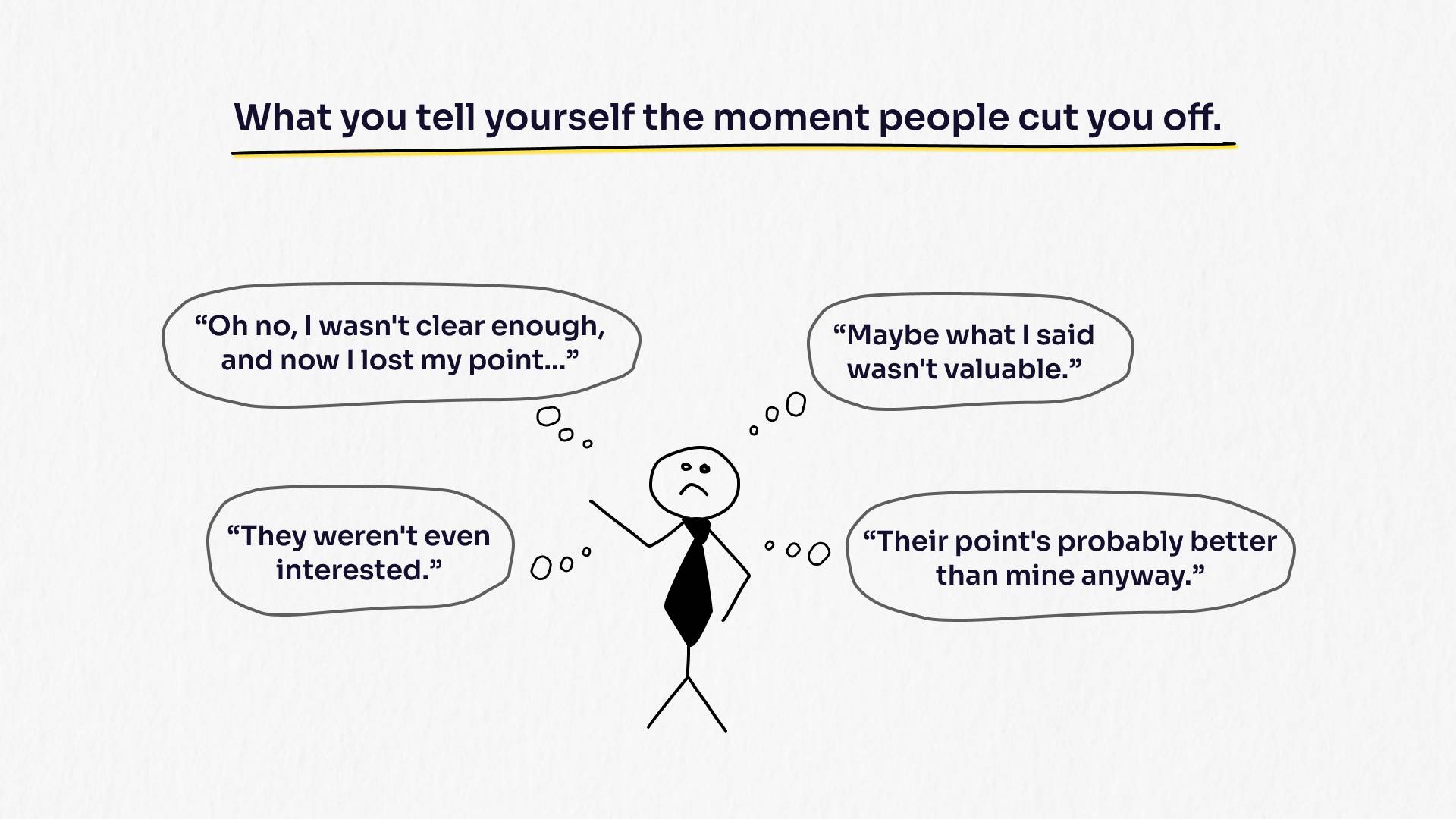
This is what coach Aman shared with Anna. None of those thoughts are true.
Most people who interrupt you aren’t deciding if you’re worth listening to. Most of the time, they’re just excited and jump in. That’s it.
The interruption says everything about them and very little about you.
You’ve just been taking it personally.
Which means the fear of being interrupted is just a symptom of the stories you tell yourself about you.

The shift that makes pausing safe
One of the most powerful mental shifts I’ve learned to fix this comes down to one thing.
Can you believe what you’re about to say is worth saying?
When you believe it, you stop reading the interruption as proof that what you said was wrong.
And once it can’t hurt you, pausing stops being scary.
You’re not afraid of the silence, or of someone jumping in.
You believe your point is worth it, so you finish it anyway, no matter what happens.
One of the best ways to overcome the fear of getting interrupted mid-talk is to get proof that an interruption can’t take your point away from you.
Two things to work on
Coach Aman gave Anna two simple things to work on. They work just as well for you.
1. Catch yourself skipping the pause
Next time you feel yourself rushing so no one can jump in, just notice it. You don’t have to fix it yet.
2. Try a prompt and pause
Start your sentence with a short opener, then pause in the middle of it. Something like “The thing I want to say is…” or “What I keep coming back to is…”
The opener tells everyone in the room you’re not finished just yet. So they wait for you to deliver your point.
So, in your next meeting, try this. Pause to gain clarity on what you want to say. If you get interrupted, no worries. Next time you speak, try using one of the sentence openers, pause, and finish your thought.
It works for both you and the people listening. You get a moment to gather your thoughts. And it pulls your listener back to your point, right when they might have been tempted to interrupt you.
If you want to practice somewhere low-stakes first, join one of our free classes. It’s a live room where you work on whatever’s getting in your way, or just watch some live coaching and learn from it.
See upcoming free live classes
Tristan
Common questions about being interrupted
Should I speak faster so nobody can interrupt me?
Speaking faster is the loop, not the way out of it. You rush, you lose the pause that would have made your point clear, and the next interruption lands even harder. The interruption was never about your pace. It was about what you told yourself when it happened. Pause anyway, and let the room catch up to you.
What do I say when someone cuts me off?
Nothing in the moment. Let them finish. When the floor comes back to you, pick your point up with an opener like “The thing I want to say is…” and finish the thought. Don’t apologize for it and don’t shrink it. You are not reclaiming anything, because the point was never taken from you.
Why do interruptions bother me so much?
Because of the story you attach to them: that you weren’t clear, that your point wasn’t valuable, that theirs is better. The interruption is the same either way. What changes how it feels is whether you believe what you were saying was worth saying. Build that belief with evidence, by finishing your thought after an interruption and noticing that nothing bad happened.
Where can I find a public speaking class with live practice?
Most online public speaking courses are videos you watch alone with one Q&A class attached to it. If you want live practice, check three things before you pay: are there real people in the room for you to practice with, do you speak in every session, and does someone give you feedback on each turn? Ultraspeaking’s cohorts are built this way: 15 live sessions over five weeks, most of them in breakout rooms of two or three with a coach, and you speak three or four times every class. Toastmasters clubs are also live, usually with one prepared speech a month.
Can I try a live class for free first?
Yes. We run a free 60-minute class, which is Day 1 of Fundamentals. It’s the first session of our Fundamentals course, live on Zoom, with the same speaking games and breakout rooms as the paid course, so you find out in an hour whether this format works for you. You need a free Ultraspeaking account to join, and the account also gives you the speaking games and self-paced courses in the app.
More related reading
Pausing and Breathing: a guide