Ever catch yourself rambling, but don’t know how to stop?
You’re in a meeting and your manager asks, “Can you give a quick update on that project?”
You start answering, “It’s going well…” But you aren’t sure what level of detail to share.
As you are talking, you think to yourself, “You spent so much time talking about delays. I’m not even sure you should have said it in the first place.” Then, “Why did you just tell her about Jack in Accounting who keeps pushing back? Is that really valuable?” And then, “There are a lot of tasks left to do, maybe it’s time to switch back.”
Suddenly, you’ve been talking for what feels like way too long, and you’re not sure where this is going anymore.
Your brain screams, “Get to the point already!”
But what is your point? At this point, you don’t even know anymore.
Most people know when they’re rambling. They just don’t know how to get out of it.
There’s a simple way to fix this.
Summary prompts are the antidote to rambling
A summary prompt is a short sentence like “Essentially, my point is…”. Think of it as Lakitu from Mario Kart, the little cloud that fishes you out of the ditch and drops you back on the track.

These small but mighty sentences are instructions for your brain to get to the point.
It’s remarkable that if you start a sentence with a summary prompt, even if you don’t know your point in advance, your brain lands the plane for you.
Summary prompts are built to help you get back on track from rambling or blanking. They also help the listener tune back in.
Six summary prompts to try
The moment you hear yourself going on and on, use a phrase like “Basically, the point is…”, “Essentially, what I’m saying is…”, “Here’s the bottom line…”, “The thing to remember here is…”, “The key takeaway here is…”, or “To wrap this up…”.
It’s still wild to me that you don’t need to know what comes next for it to work.
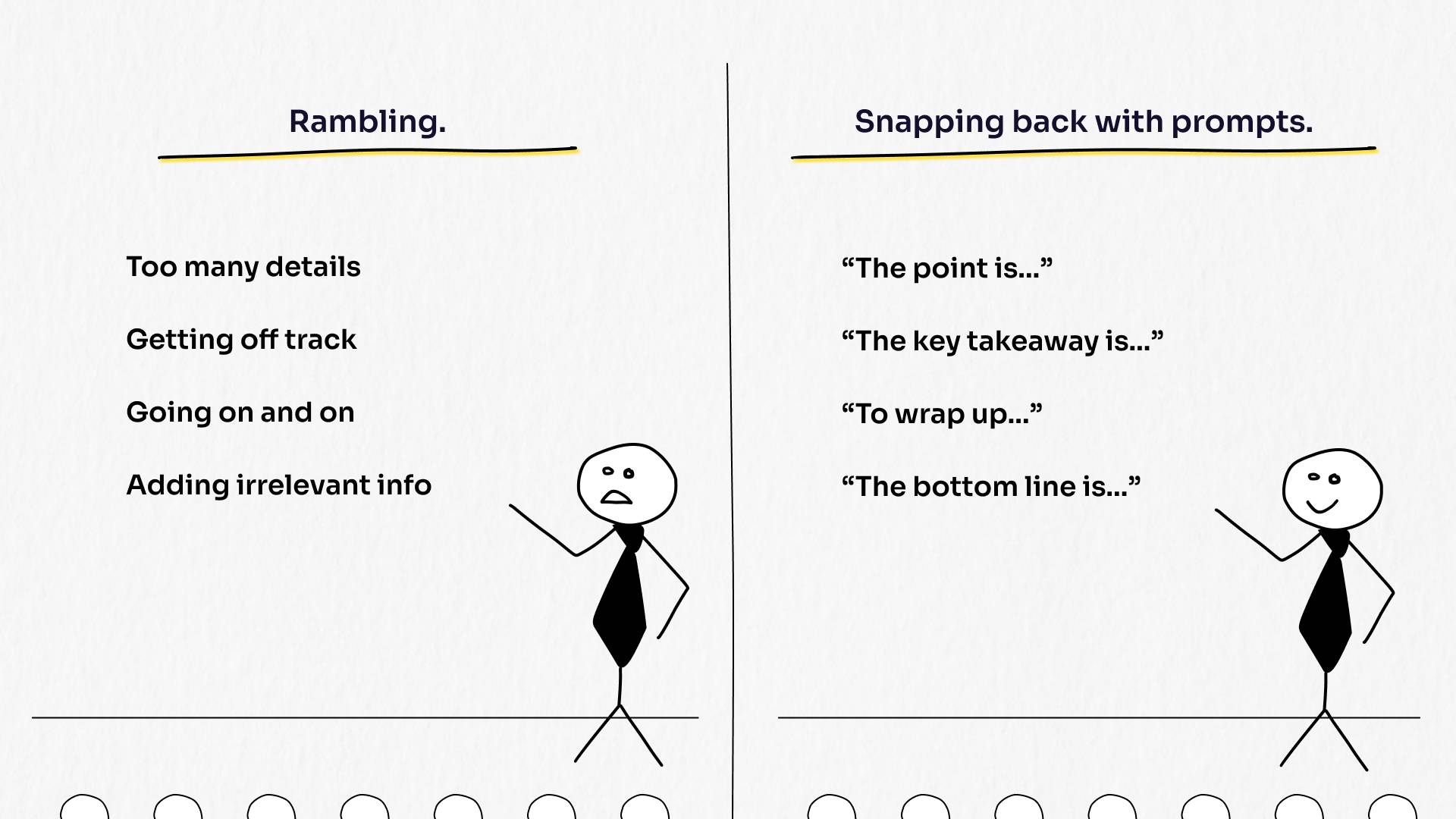
The prompt opens a loop, and your brain rushes to close it. The sentence that makes it click just appears.
It’s like your subconscious already knows the point. It just needed permission to say it.
You end strong instead of trailing off or feeling embarrassed.
Why rambling once in a while is fine
These prompts are what can make even the most seemingly terrible speakers incredibly impactful.
Recently, I went down a very deep rabbit hole, watching dozens of hours of Elon Musk speaking.
What I find fascinating is how far his speaking style is from anything we’d typically call a good speaker. He often rambles, fumbles, and goes deep into neuroscience and physics.
But then, he drops one sentence that pulls himself and the listener back to clarity.
We’ve all been in a situation like this, watching someone lose their point. You feel impatient and uncomfortable. You desperately want them to get to the point. And when they finally do, you feel this beautiful release. That’s the feeling you are left with.
So it doesn’t really matter if you ramble once in a while, as long as you end strong. That is what people remember.
Try it this week
Next time you find yourself rambling, rather than saying “Sorry, I’m rambling…”, use a summary prompt like “The point is…”, and you’re back.
If you want the prompt to be there when you need it, practice it before the meeting. The free Ultraspeaking app has timed speaking games that put you on the spot, so you can try summary prompts when nothing is at stake.
Tristan
Common questions about rambling
Why do I ramble even when I know the topic well?
Knowing the topic was never the problem, and neither is starting to talk before you have the whole answer worked out. Rambling is a landing problem. Under pressure your brain keeps adding detail while it waits for an instruction to close, and nobody gave it one. Your brain already has the point. A summary prompt is the instruction that tells it to deliver it, which is why it works even mid-sentence.
Should I prepare my answers in advance so I don’t ramble?
Scripting every possible answer doesn’t hold up, because meetings don’t follow the script, and a script pulls your attention out of the room and into your notes. Prepare how you want to show up instead, clear and direct, and trust that your brain can fill in the words. The summary prompt is a tool for the moment, not a replacement for presence.
Isn’t “basically, the point is…” just a verbal crutch?
Only if you say it on autopilot. Used once, when you mean it, it is a signpost, and listeners welcome it because it tells them where to tune back in. The real crutch is “Sorry, I’m rambling.” That line announces the stumble and invites the room to judge it. The prompt keeps you in character and moves everyone forward.
Does the course come with the training app?
Yes, and you don’t need the course to get the app. Anyone can create a free Ultraspeaking account and use the speaking games, the self-paced courses and the free live classes. The cohort adds the part the free app can’t give you: weekly structure, a coach watching, and feedback on every turn, three times a week. Students keep using the app between sessions, for other live classes happening daily.