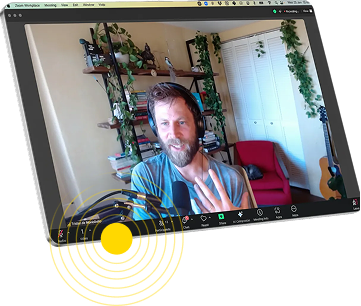
Six weeks ago, I had one of the most touching conversations with an Ultraspeaking student who graduated from Fundamentals in April.
He went from feeling shy and anxious with social interactions to sending me an email that made me tear up a little (more on that soon).
But the part that stuck with me most was how he described his everyday life. It’s the loop so many of us get stuck in, including myself.
When I lived in France, my colleagues would always say, “Métro, boulot, dodo,” which means “commute, work, sleep, then get up and do it all over again.”
You keep meaning to make new friends, or call the one you miss, or just become the kind of person who can talk to anyone. But who has the time? (Or if I’m honest with myself, who has the nerves?)
You end up a little more disconnected than you’d like.
So when Nelson told me his routine was “work, gym, home, work, gym, home,” I thought, I relate to this so much. And I bet other people do too.
Nelson’s story
Nelson is an IT professional who lives in Mozambique. He did our Fundamentals cohort in his second language (already braver than me. I could never be brave enough to do Fundamentals in French).
Before that he felt he had no social life for years.
This was never really about a lack of time. It was pure anxiety from just the thought of starting conversations with people.
“I had this fear that I used to feel in my chest when I saw people,” he told me.
Conversations felt genuinely dangerous, so he avoided them.
At work, he was so shy that he felt like his colleagues started keeping their distance, which, in his words, “got into my head a lot.”
What he wanted was so simple. He wanted to walk up to a person, say hi, and strike up a conversation with no agenda at all.
To be the guy who’s easy with everyone, a bit like the mayor of every room he walks into.
So Nelson looked for solutions to this physically painful anxiety. And he looked. Therapy, meditation, all the books, even a course on building social connections.
Everyone gave him advice that made it worse. “I tried ‘just put yourself out there.’ But that didn’t work. I felt even more afraid.”
Why “just put yourself out there” backfires
Because waiting for the big, high-stakes moment is exactly when our nerves are spiking.
Then we throw ourselves in, feel like we fumbled it, and walk away more afraid than before. So next time we brace even harder. And it gets worse by the minute.
Think about how people get good at anything else.
Athletes train constantly, simulating the pressure of the game. They don’t practice a new skill for the first time during a real game.
And yet for some reason, we do expect that will work with building communication skills.
We see a cool framework on how to stop rambling and we practice it in the real world for the first time.
Many people who want to become better communicators live in the black, out in the real world, with barely any safe practice.
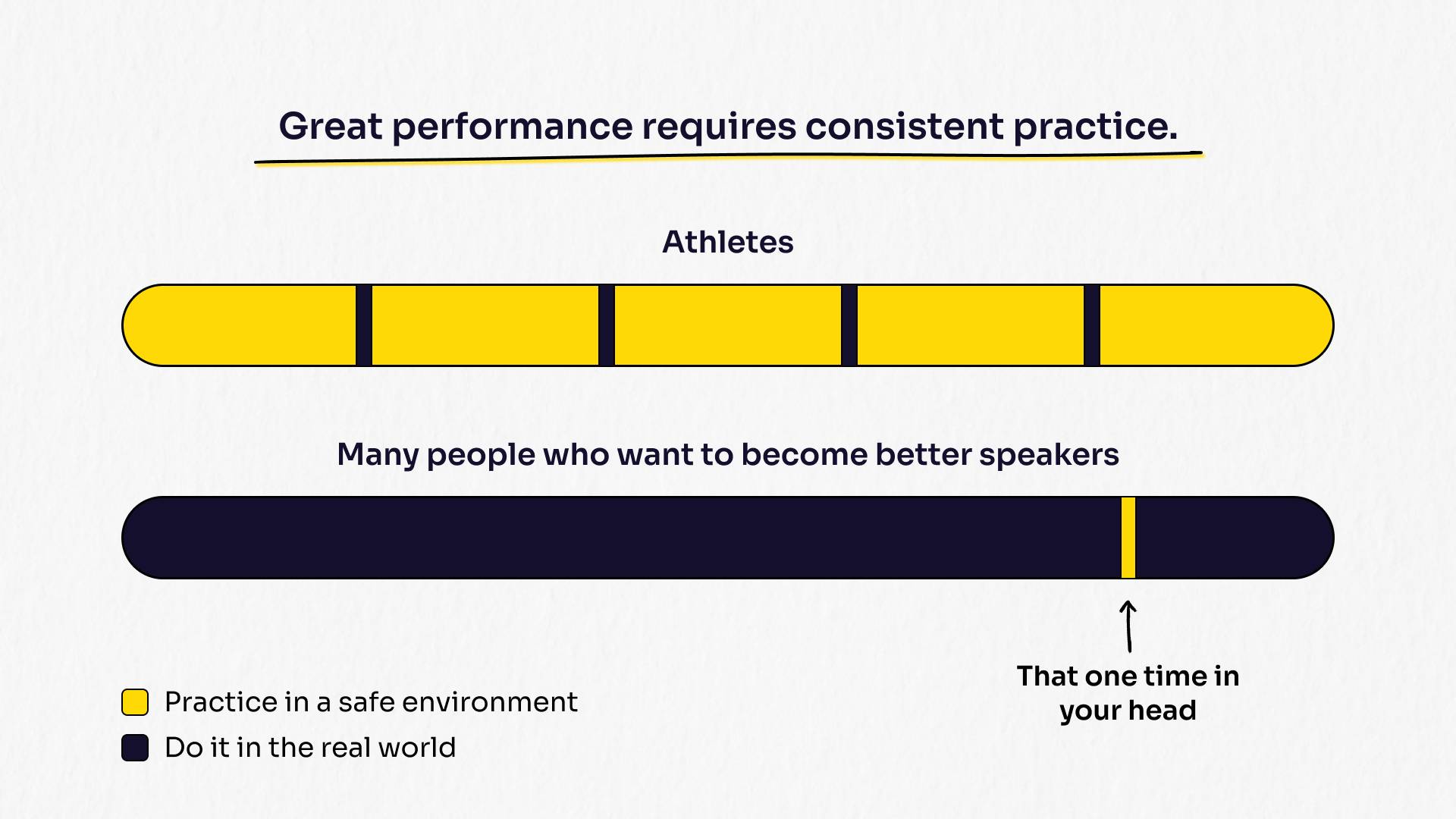
That was Nelson’s whole first year of trying to talk to people. Fighting the fear alone in his head, forcing himself into the scary moments, feeling like it didn’t go well and getting more afraid after that.
What changed
So he decided to join the Fundamentals course.
For five weeks in a row, three sessions a week, he practiced talking to people working on the same thing he was, with coaches and other professionals giving him feedback.
You learn by practicing through speaking games that make you feel like you are under pressure, but the stakes are low. So it doesn’t matter if you fumble, ramble, or blank.
And it worked.
After an Ultraspeaking practice round he thought he’d bombed, someone told him, “you’re good at thinking on your feet.”
(Isn’t it nuts how one line from someone you barely know can completely shift your mindset?)
So one day at the gym, Nelson decided to try it for real.
He wanted to strike up a small conversation with someone, and right on cue, that old voice showed up. “You’ll mess this up. They’ll think you’re weird.”
He realized that voice never fully goes away.
The difference is that now, he has the confidence to override those thoughts.
He’s had enough reps in class to know the pattern: every time he was sure he’d bombed, it turned out he hadn’t. So he went for it anyway and started a small, easy conversation with the person.
The Nelson from a year ago would have stayed quiet and beaten himself up about it for the rest of the day.
But this time at the gym, he didn’t. The person he wanted to talk to had no idea what was going on in his head. So he reached out anyway, made a bit of small talk, and walked away feeling on top of the world.
Looking back, Nelson remembers that day like this: “That never would have happened without Ultraspeaking.”
I asked where all this was headed for him. Why did it matter to him?
“I have this colleague who’s a really cool, outgoing guy. Everyone knows him. I want to have that presence and magnetic energy. It’s an identity shift.”
Here we are about six weeks later and I got this email.
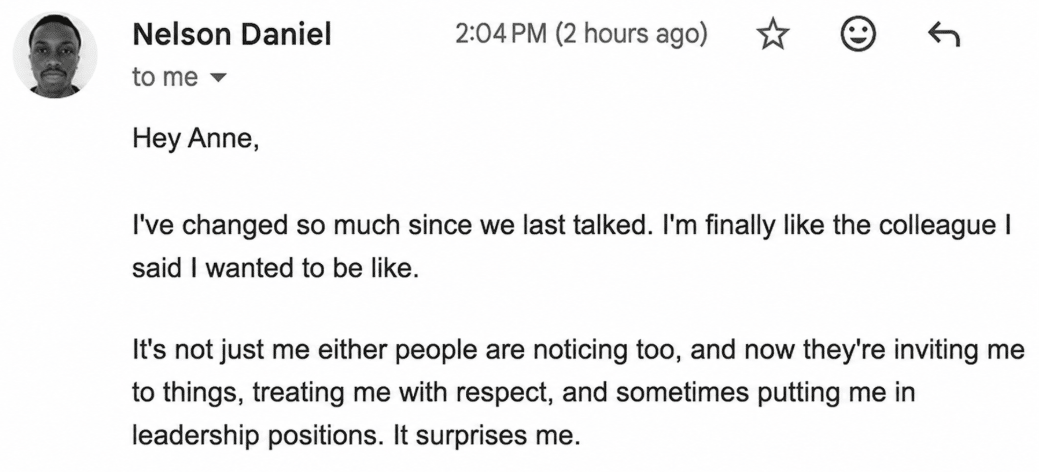
I get a little emotional (and very excited) just typing this.
If you can relate
If you can relate to Nelson’s story, you’re probably not after a tip for next Tuesday’s meeting.
You want to be the person who people listen to and look at and say, “Wow. They are so calm and chill.”
The way to get there is like Nelson did. Not by practicing in the big high-stakes moments, but by practicing in a space where the pressure is on, but it’s safe to experiment and mess up. And where you get feedback that points you in the right direction.
That is what Fundamentals is: five weeks, three live classes a week, in small groups with a coach. If you want to feel what it’s like first, our free live class is the same kind of room for an hour.
See upcoming free live classes
Anne
Common questions about social anxiety and talking to people
Why does “just put yourself out there” make the anxiety worse?
Because it asks you to try a new skill for the first time in the scariest possible moment. Your nerves spike, the attempt feels like a fumble, and the fear gets a new piece of evidence. Athletes don’t learn a move during the game. The practice has to happen somewhere the pressure is real but the stakes aren’t, so the evidence you collect is the kind that shrinks the fear instead of feeding it.
Does the fear ever go away completely?
Nelson still hears the voice at the gym. What changed is that it no longer gets the final say. After enough rounds where he was sure he’d bombed and found out he hadn’t, he knew the pattern, and that knowledge is what lets him start the conversation anyway. You don’t remove the voice. You stop believing it.
Is this really a speaking problem or a social one?
They are the same muscle. Starting a conversation with a stranger, answering a question in a meeting, and speaking up with an idea all come down to whether you can say something before you feel ready and stay yourself while you do it. That is what the speaking games train, which is why practicing on Zoom with strangers changed how Nelson walked around his own office.
Does practicing speaking actually make you more confident at work?
Yes, but not the way people expect. Practicing alone doesn’t make the fear go away. It shortens the gap between feeling it and speaking with confidence anyway. What I find most helpful in building confidence is the feedback after a practice rep. When Nelson used to get advice “just practice” it made him more nervous. He would try it and never know how it landed. Through the Fundamentals cohort, it wasn’t just the practice, but the feedback loops that gave him the confidence to speak through the awkward moments he used to dread with strangers. I’ve watched the same thing happen in our cohorts with people who had never once spoken up in a meeting.
Do online public speaking courses actually work?
The video-based ones don’t, because you can’t learn to speak under pressure by watching someone else. It’s like learning to swim by reading a book about swimming and never getting in the water. Live practice-based courses are different. Nelson did Ultraspeaking from Mozambique, on Zoom, in breakout rooms with two or three other people and a coach, and it worked because he was speaking, not watching. Ask one question of any online course: how many minutes will I spend talking to real people? If the answer is zero or an hour session, keep looking.