My co-founder, Michael’s favorite quote comes from an improv teacher: “Great improvisers don’t wait for great ideas. They take average ideas and make them great.”
It means you don’t need the perfect thought before you start. You begin with whatever shows up and make it work along the way.
Which is the exact opposite of the advice we’ve all been handed for thousands of years: “Think before you speak.”
I want to challenge that idea.
We try to reach for the perfect answer before we open our mouths. And under pressure, that turns into overthinking.
Pretty quickly, “think before you speak” turns into “overthink before you speak” in practice.
What happens when you’re put on the spot
Imagine you’re put on the spot with a question in a meeting.
You do something seemingly smart. You pause, and you think.
And then you think more, and more. And the more you think, the worse it gets. No answer shows up.

By the time you speak up, it comes across as unsure, even when your answer is good.
We’ve seen this over and over, coaching clients from all walks of life. Executives, managers, engineers, everyone.
We put someone on the spot and asked them a question. Then we paid attention to something that might surprise you: how long they stayed in their head before a word came out.
The longer they stayed, the less confident they seemed when they finally spoke. And the less clear they were as a result.
Michael explored this in one of his Ultra Theory classes with a great example. If someone asks you, “What’s the greatest invention in the world?”, your first thought might be “the lightbulb.” On second thought, “No, it was the internet, actually.” And then, “Wait, is the internet really that great?”
Then you realize people are waiting for an answer, you’re running out of time, and you haven’t decided which one to give.
By the time you speak, your answer is buried under a pile of doubt.
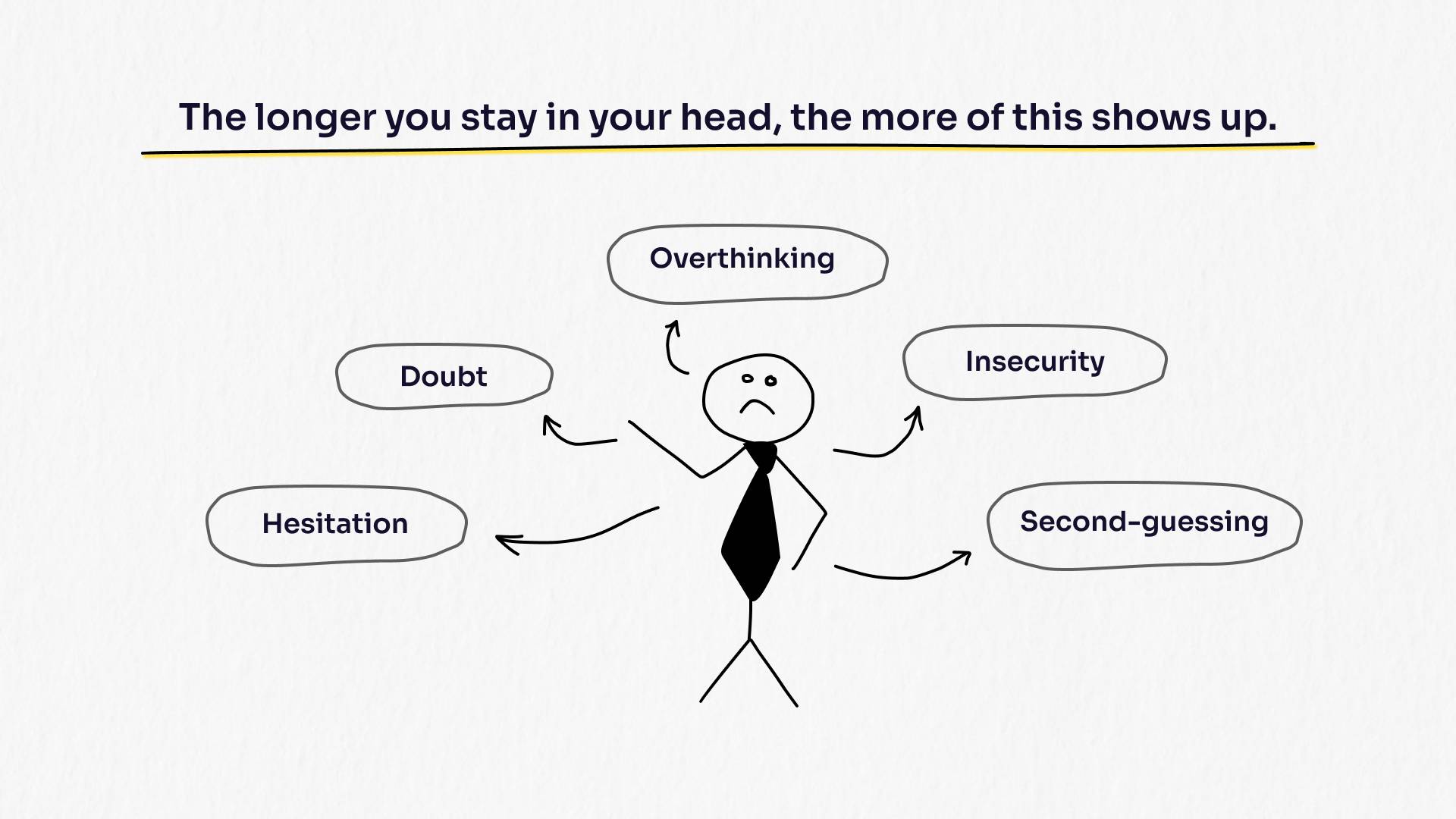
As a result, it comes out flat, and the energy’s gone. Even if your answer is good, people listening will mark it as only okay.
That’s why “just think a little longer” only makes it worse. More time in your head means more second-guessing, and more hesitation leaking into your voice.
At Ultraspeaking, we teach the opposite: speak before you overthink
Think about the last time you had to write something and stared at a blank page.
The cursor blinks for minutes on end, then you type something and hit backspace a dozen times. The deadline creeps closer. An hour passes, then two. By your standards, not one sentence comes out good enough. It’s paralyzing.
But notice, the most effective writers don’t advise you to sit there and think until the perfect first sentence comes out. They start writing, put down some bad sentences first, and let the ideas start flowing.
With speaking, it’s the same logic.
Speaking before you overthink is like unclogging the pipe. When the water is flowing, you can channel it.
You might still want to pause to find your clarity. But at least the flow of ideas is going.
It’s like an investment. You spend a rocky first sentence to buy a clearer one later.

The prompt to use when you don’t know what to say
One of the easiest ways to get more clarity on the fly is to use a prompt.
When you don’t know what to say, kick off with this: “The interesting thing about this is…”
Say it with energy, and go with the first thing your brain comes up with.
Your brain has an incredible power to fill in the rest when prompted. Even if you begin in the wrong direction, you’ll end up somewhere good.
The more you practice it, the less you brace yourself, and the more you trust that you can come up with something good. With every rep, you get a clearer sentence and prove to yourself that you can speak without overthinking.
And once you trust that, everything else gets stronger, including your preparation before the big moments.
“What if I just end up saying something dumb?”
At Ultraspeaking, we are big believers in practicing in rooms that simulate the real world but don’t carry the high stakes of the workplace. If you say something “dumb” in front of other people practicing with you, it’s okay. Nothing bad will happen.
We see it over and over with our students. After practicing, they develop the skill of prompting their brain to come up with something on the fly, rather than overthinking every answer.
If you’re not sure this will work for you, don’t try it at work for the first time.
Practice the prompt “The interesting thing about this is…” in a free live class with us first. You show up, practice with others on the same path as you, and our coaches give you feedback in the moment.
See upcoming free live classes
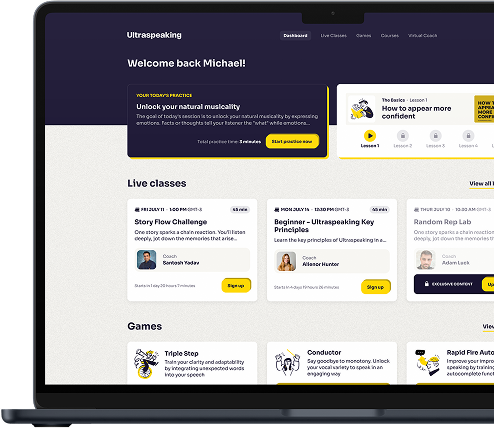
Or try it on your own first in the free Ultraspeaking app, where the speaking games put you on the spot with a timer.
Tristan
Common questions about thinking on your feet
Doesn’t speaking before I think mean I’ll say things I regret?
Speaking before you overthink isn’t blurting. It is starting with your first honest thought instead of waiting for the perfect one. The first sentence is an investment that buys a clearer second one, and you can still pause for clarity once the flow is going. What you regret in meetings is rarely the first thought. It is the long silence before a hedged version of it.
Why does pausing to think make me sound less confident?
Because the room reads the hesitation, not the quality of the thought behind it. A good answer buried under doubt gets marked as only okay. Conviction is upstream of words. A thought delivered with energy lands better than a perfect one delivered flat, which is why we work on the state you speak from before we work on what you say.
How do I practice this without risking it in a real meeting?
Use the prompt in a room where a bad answer costs nothing, with people on the same path as you. Then pay attention to how much faster your brain fills in the blank from one rep to the next. That noticing is what changes the habit, not the number of reps. Once you’ve seen yourself do it, you have a choice in the meeting that you didn’t have before.
Is there a free app for daily speaking practice?
Yes. The Ultraspeaking app is free and built for this: short speaking games where a prompt appears, you have to start talking, and the clock runs. Rapid Fire Analogies, Triple Step, Conductor and a few dozen others. The games are used in our cohorts and live classes, so if you like them, the paid version builds on that with real people and a coach in the room.
Will this help me in a job interview?
An interview is being put on the spot for an hour, so yes. The pattern is the same: in an interview, you get questions you didn’t predict with another professional you are working to connect. This is often what you are experiencing in your breakout rooms when you are practicing. What helps is the thing above: Practice it inside the cohort, daily live classes, and with the private coaching that comes with the cohort. If you aren’t part of a cohort, start with the free live classes inside the free training app to get started. Our advice for interviewing is don’t try to memorize every possible answer. First, it’s impossible. And interviewers can hear a script. They want to get to know you and don’t want to speak to a robot.