You know that feeling where you believe something strongly, but when you say it out loud, it comes out watered down.
“I think we should maybe consider doing this differently?”
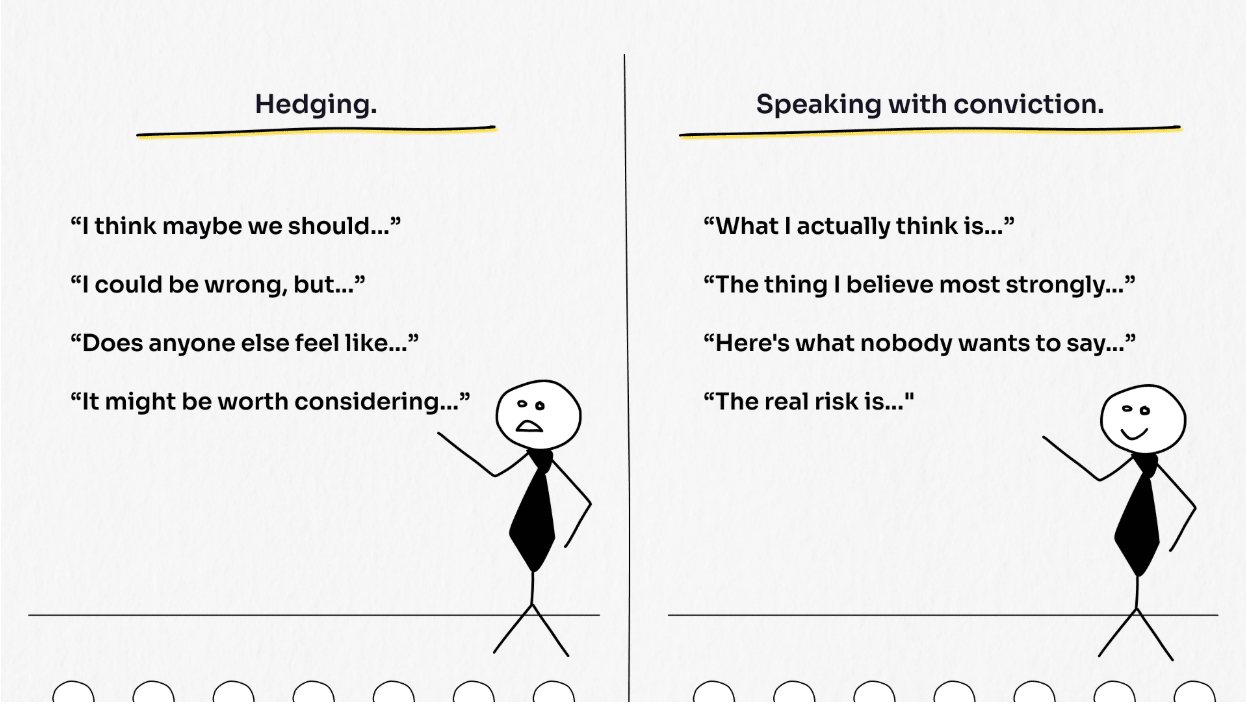
Instead of stating your point with conviction, you hedge. “I just feel like maybe we should…” “I could be wrong, but…” “Does anyone else think that…”
And it’s not because you’re unsure.
It’s because stating what you believe with full force means putting yourself on the line. And that’s scary.
So you soften it, round the edges, and add qualifiers until your point has no teeth left.
If you’re like most of the people I coach, you believe this is a confidence problem.
But people who sound “confident” are just willing to say the strongest version of what they think, out loud, before they feel ready.
It’s vulnerable. It’s putting yourself out there. And using bold language to do it.
What Brené Brown does differently
Brené Brown is the best example I have ever seen of speaking with vulnerability, but doing so with conviction.
She’s one of the most requested guests on the world’s biggest podcasts.
Ask anyone what makes her so captivating, and they’ll say vulnerability.
That’s only half the story.
Brené has a second ingredient most people are missing. When she combines the two, it’s the reason you can’t stop listening to her.
We spent weeks studying her interview on the Diary of a CEO podcast.
There’s a moment in the interview where Brené is mid-thought. She’s searching, not sure where she’s going with her sentence.
She doesn’t say, “There was this one part of my career that was kind of hard…”
Instead she says, “The most painful part of my career was…”
Suddenly, she’s locked in. And so are we as listeners.
The next thing out of her mouth is one of the most powerful moments in the entire conversation.
That sentence forced her brain to deliver something powerful with conviction.
She does it again later: “Let me tell you what scares me the most.”
This sentence gives your brain permission to say something convincing.
What a conviction prompt is
At Ultraspeaking, we call these conviction prompts.
Conviction prompts are sentences that start with such a strong commitment that your brain has no choice but to finish the thought.
You don’t need to know your point before you start talking.
Conviction sentences send a message to your brain to speak with conviction first, and the feeling shows up after.

Turning up the volume
But Brené goes further than delivering her message with conviction prompts.
When she lands on a point that matters to her, she turns up the volume.
Most people would say, “This was a tough chapter to write,” or “This is really important,” or “People don’t usually ask me about this.”
Brené says, “The hardest chapter I’ve ever written in my life.” Or, “I don’t think we’ll ever talk about anything more important than this.” Or, “No one’s ever asked me this. And no one’s going to like the answer.”
The difference is that Brené reaches for the strongest, most exposed version of the same thought instead of the safe one.
For you, that might be extremely challenging.
Because the strongest version of what you think is also the version people can push back on the most.
You avoid vulnerability because it can bring rejection. What if you put yourself out there and you are wrong? It feels risky.
But standing up for what you believe is what makes people stop and listen.
Six conviction prompts to try
So next time you’re in a meeting, and you feel yourself about to hedge or dilute your message, try this. Pick one of these conviction prompts to start your sentence: “One thing I truly believe is…”, “The most painful part is…”, “The craziest thing is…”, “There’s no question in my mind that…”, “I can’t emphasize this enough…”, or Brené’s own favorite, “Let me tell you what scares me the most.”
You’ll feel exposed for about two seconds. Then your brain delivers, and the room will listen.
And if it feels uncomfortable at first, remember this. Brené Brown wasn’t always this captivating. Speaking with conviction and vulnerability came from practice. She challenged her brain to deliver her best thinking with each conviction prompt.
You can start doing the same thing today. We made a full video breaking down exactly how Brené uses these techniques, with clips and timestamps so you can see the moments unfold.
And if you want to try the prompts out loud before your next meeting, the free Ultraspeaking app has speaking games that put you on the spot with a timer, so you can practice committing to a sentence when nothing is at stake.
Tristan
Common questions about speaking with conviction
Is speaking with conviction the same as being arrogant?
No. Conviction is saying the thing that is actually true for you, as strongly as you actually hold it. Arrogance is managing how you land on other people. The first keeps your success in your own hands. The second hands it to the room. Brené Brown is the proof that you can be fully vulnerable and fully convinced in the same sentence.
What if I say the strong version and I turn out to be wrong?
Then you were wrong out loud, which is survivable, and you update. A conviction prompt commits you to finishing the thought, not to being right forever. The hedge was protecting you from the feeling of being wrong in front of people. Once you have been wrong in front of people a few times and nothing bad happened, the hedge has nothing left to protect.
Do conviction prompts work if I don’t feel confident?
That is exactly when they work. The sentence goes first and the feeling follows, not the other way around. Your mind already knows how to put words to a strong commitment. What it needed was permission to start, and “There’s no question in my mind that…” is that permission.