A few days ago, I interviewed Chaz (an Ultraspeaking student). It was one of the most valuable conversations I’ve had in months.
Today, I’m sharing his story with you, because I think this will hit home.
This is for the professional who sits in leadership meetings, 1:1s with their boss, and cross-functional syncs, and walks out knowing they left the thing they wanted to say, unsaid.
It’s for you, the director who wants to be seen as strategic.
Or the senior IC who has the most expertise in the room, but doesn’t convey it.
Or the manager who keeps getting feedback that their point “wasn’t clear.”
This is what Chaz was experiencing.
Chaz is a Director at a fast-growing medical device company, attending bigger leadership meetings every quarter with greater weight placed on every word.
“I was feeling a little unconfident when I’d be at these leadership meetings, when I would be speaking to colleagues about ways I view the business… And at the end of the day, I felt like I wasn’t really contributing. I was yielding to everybody else’s perspectives,” he said.
I see yielding show up in different ways for different people: “I could be wrong, but maybe we should consider…”, “Just throwing this out there, feel free to ignore…”, “I’ll defer to the room on this, but…”, “I hear what you’re saying, and I agree, except…”, or “Not to push back too hard, but…”
Now, this is the part where I could hand you a list of conviction prompts. And for some people, that will work well.
If you recognize yourself in those sentences, chances are the hedging is the symptom of something underneath causing it.
And if you only try to stop the hedging at the surface, you’re not solving the issue for good.
It’s like someone who quits smoking and then starts biting their nails. The root cause is anxiety and it keeps finding a way out in different ways until it is solved.
But the goal is to go deeper, to help you understand the layers of what’s holding you back in your speaking.
For Chaz, it started with one simple question during a call with Ashley (Ultraspeaking Coach):
“Where are you struggling?”
To answer that question, she worked through what was driving the hedging, layer by layer.
Here are the 3 layers that helped us uncover Chaz’s hedging symptoms, and how they might apply to you and your professional life.
Layer 1: The hedging is doing a job for you
Hedging is protecting and limiting you at the same time.
In Chaz’s words:
“It was all born underneath the subconscious desire to be friendly and make friends and have people like me.”
He discovered he was a people-pleaser.
He tried to please everyone, stay friendly, make friends, and keep all the relationships intact.
But look, every time you soften an opinion, your brain creates quiet rules that go something like this:
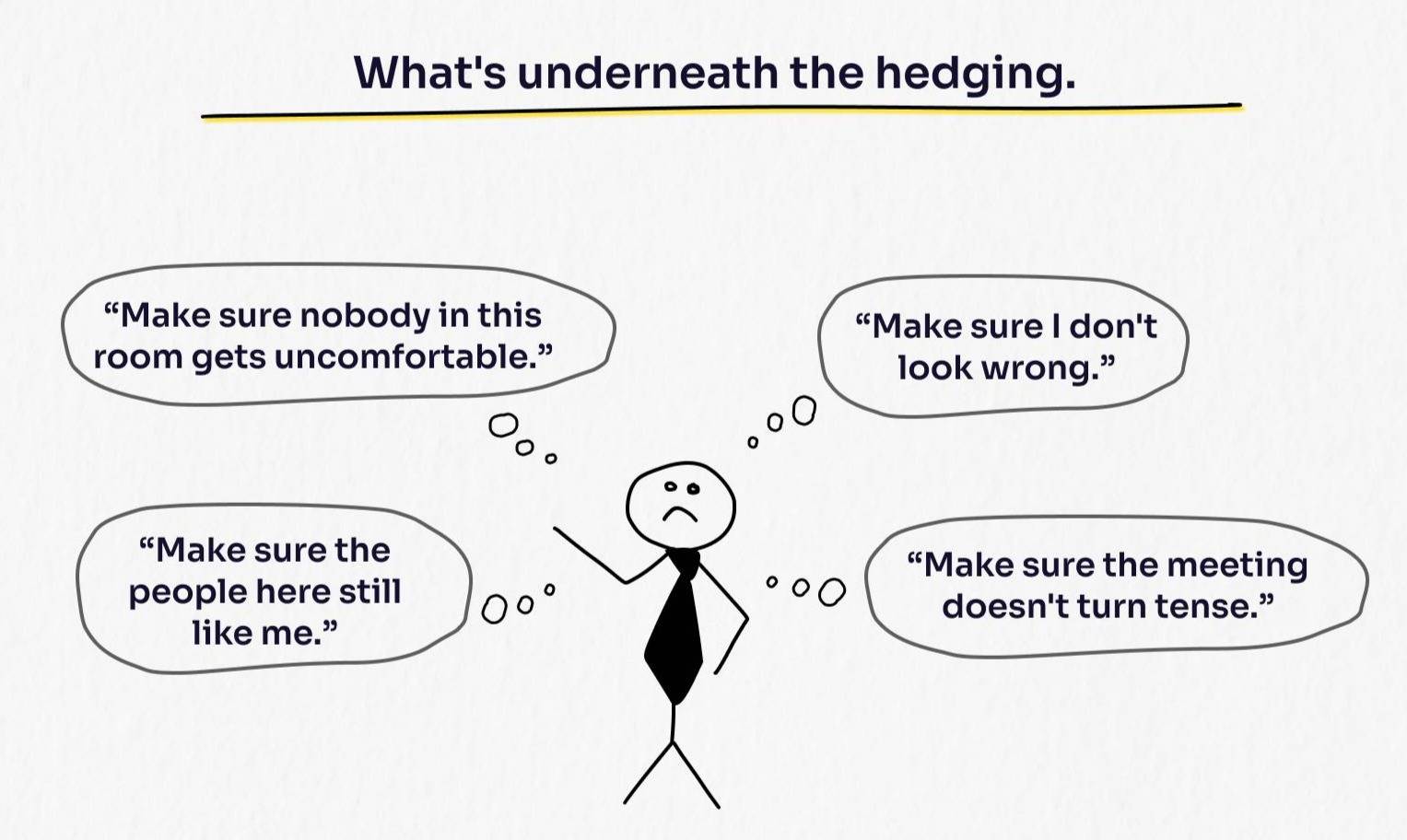
That might keep the room comfortable.
But it can also keep your real thinking out of every meeting… Just like what happened to Chaz.
Nine months ago, he received feedback from his boss:
“You’re too task-focused, not a strategic thinker.”
The people-pleasing took away the opportunity for him to build his strategic chops and brought him to the safe place of doing the tasks, which makes people happy.
At that moment, it’s comfortable. But the costs add up:

And the worst part is that they show in the long-term.
Layer 2: The pattern is subconscious, which is why no tactic has worked
A subconscious pattern never asks your permission. It runs before you’ve had time to think.
By the time the sentence leaves your mouth, the hedge is already there.
That’s why the tools you’ve tried haven’t held: a conviction prompt, a framework, a script.
These are all conscious tools, and they definitely help. But they live a floor above where the pattern is running, on layer 3.
Layer 3: When you hedge, you haven’t accepted that your voice belongs in the room
When I pressed Chaz on what was underneath everything, he said something I can’t get off my mind:
“I have to realize my opinion isn’t a threat to you.”
I see many people-pleasers are carrying this without ever finding words for it.
It’s like an implicit belief that if they take up the space an opinion requires, they will cost someone something. Like, damage a relationship, or be “too much.”
That belief is the engine of hedging. So hedging feels necessary, even kind.
But it’s just a “coping mechanism.” It doesn’t solve the root cause.
At Ultraspeaking, we’ve seen that practicing with other people is the fastest way to tackle the root cause.
The first time you say what you really think, instead of the softer version, your nervous system desperately wants to hedge, you don’t know how people will react.
You are breaking the pattern that has been protecting you for a long time.
Going against it feels less safe than staying inside it.
This is why at Ultraspeaking we don’t have you practice alone.
We put you in a room with other students who are trying to do the same thing. They want to grow. They want to hear the real version of what you think, not the watered down one.
You say the scary version of what you think, and the room responds. Sometimes it resonates, sometimes it doesn’t.
Either way, you start collecting evidence that telling the truth in front of people doesn’t end the way your subconscious told you it would.
And this is something Michael and I have been trying to put words on for years.
We call it coming home. It’s the process of rediscovering yourself, and allowing yourself to self-express.
It fits into what Michael describes as the 3 ranges in the journey of speaking:
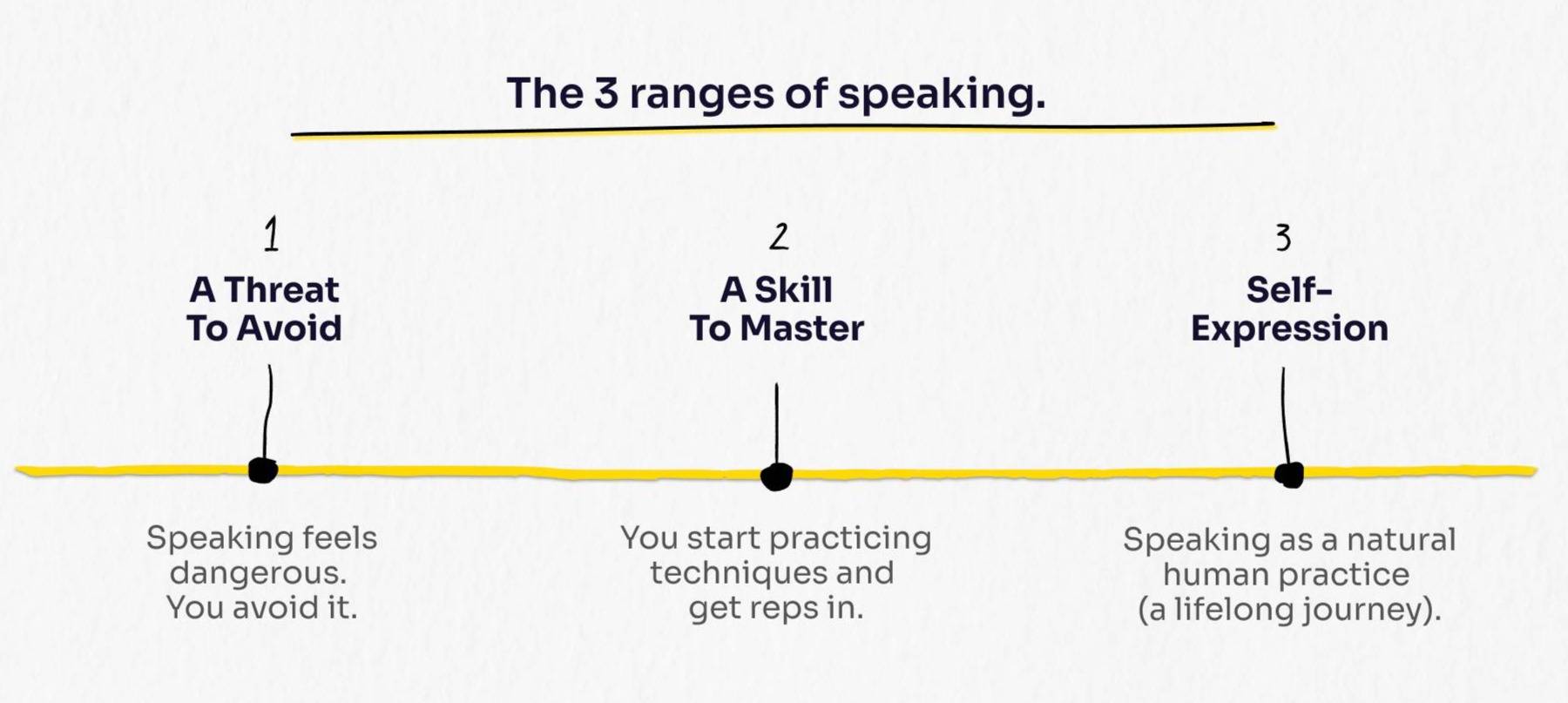
Speaking as self-expression is what it is to be human.
It ties into how you see yourself, how you relate to other people, and your inner voice. It’s unlimited. The journey never really ends.
If reading about Chaz’s story is relatable, I’d love for you to join us for a free class and challenge yourself. You can practice with other people and challenge the scary feeling of saying what you think.
When you stop hedging, or when you stop performing a safer version of yourself, something starts to rearrange inside your subconscious. That’s when you start shifting towards speaking as self-expression.
This is what gives me shivers and makes me want to do this work forever.
Self-expression is where Chaz is heading. And it’s what’s waiting on the other side of doing the work underneath the hedging, or any other limiting speaking trait. So, start today.
Tristan
Common questions about people-pleasing at work
How do I stop people-pleasing at work?
Don’t fight it head-on. People-pleasing is doing a job for you: it keeps you liked and keeps the room calm. If you just ban the soft phrases, the need underneath finds another way out. Replace the belief instead. Chaz put it best: “My opinion isn’t a threat to you.” You only start believing that by saying the real version out loud and seeing what happens. Do it first in a room where people want your honest view, then bring it to work.
Will I come across as rude if I stop softening my opinions?
Almost never. Directness, said warmly, is a form of respect. It tells people you trust them to handle your real thinking. The softened version feels kind, but it quietly withholds the thing they need from you, which is your view. Most people who worry about sounding rude are so far from it that saying it plainly lands as clear, not harsh. You can stay warm in your tone and still be direct in what you say.
Why do I keep getting feedback that I’m not strategic?
Often the strategy is there, but it stays in your head. You hand the room the safe version: the task, the update, the agreement. People can only judge the thinking you say out loud. Chaz heard “too task-focused, not a strategic thinker” because people-pleasing kept him in the comfortable place of doing tasks. The fix wasn’t learning strategy. It was getting comfortable saying his view of the business before he knew how people would react.
Where can I practice saying what I really think?
Practice with other people, out loud, somewhere the stakes are low. Practicing alone doesn’t touch the fear, because the fear is about how people react. In our free live class, you speak on the spot with other people who want to hear the real version, not the watered-down one. If it clicks, the Fundamentals cohort gives you weeks of that practice with a coach, so the new pattern has time to stick.
How do I speak up in meetings when I’m shy?
Being quiet isn’t the thing to fix. Chaz wasn’t short on ideas. He was protecting relationships by softening them, and holding back often does the same job for quieter people: it keeps you safe from a reaction you can’t predict. Tips like “speak in the first five minutes” help a little, but they work on the surface. What changes it is saying what you really think in a room where it’s safe to, again and again, and finding that people respond better than you feared. That’s why we have people practice in small breakout rooms, not alone.
How do I disagree with my boss respectfully in a meeting?
Say what you actually think, plainly, and stay curious about their view. The respectful part isn’t the softening. “Not to push back too hard, but…” tells your boss your point is weak before you’ve made it. Chaz put the shift well: “I have to realize my opinion isn’t a threat to you.” An honest disagreement with your reasons is a contribution to the decision. Then ask what you might be missing, and mean it. If that still feels too risky, try it first with people who aren’t your boss, where the stakes are low.