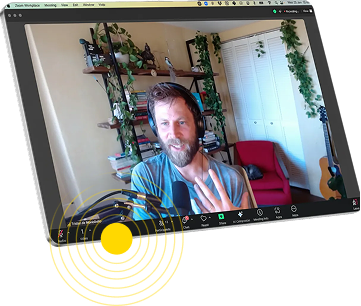
A few weeks ago, we ran a workshop at a creative agency called Article Group on how to stay composed and confident under pressure.
They felt so inspired they asked if we could leave some tools for them to continue working on their communication skills and overall confidence.
What they did is so cool: they practiced with colleagues.
Most people tend to treat communication as a personal development project they should work on privately.
Usually, it’s because they’re too embarrassed. So they read books on their own. Or practice in front of the mirror.
But this team kept practicing together after our workshop.
Each department started running its own practice sessions, using time from meetings they had already booked to play the Ultraspeaking games together.
They also used freestyle rapping as a tool to practice presenting and answering tough questions from pretend tricky clients.
Nobody made them do it. They wanted a way to keep practicing with other people at work.
When I asked the Chief People Officer of Article Group what she thought about the team practicing communication skills together, she said, “The Ultraspeaking workshop helped our team improve their confidence. They know that when they get stuck, they have permission to pause and use language to get back on track. What I’m most excited to see now is each department leading its own practice sessions. People are using the games and shared vocabulary to practice with one another.”
Their presentations got better, their communication with clients got better, and so did the speed at which they got things done as a team.
You’re practicing to be understood by people, without any people there
Think about the last time you sat in a room full of smart people who are good at their jobs.
Almost every one of them was probably struggling with the same thing you do when it comes to speaking. Rehearsing the sentence before saying it. Holding back an opinion because somebody might think it was dumb. Rambling through a shaky voice when you do speak your mind.
After the meeting, you drive home, replaying it all, feeling guilty and frustrated about how you presented yourself.
We see many people look for the same solutions. Memorizing the lines, so there’s nothing left to get wrong. Scripting the answers to the questions they expect. Reading or watching videos about speaking tips, then hoping they work when the stakes get high.
All of which rarely works, because you’re trying to solve a live, messy problem in a quiet place, by yourself.
You’re practicing to be understood by people, without any people there.
The best way to work on your communication skills is to practice with other people.
And the best practice partners might be three desks away from you.
The colleagues you’re too self-conscious to stumble in front of are the same people you could be getting better with. They probably face the same challenge.
Three things that happen when you practice with colleagues
1. You’re working on something together
Picking a skill and getting better at it with the same people gives you a shared mission.
You’re all in it, all a bit bad at it, all trying to get better at the same time. It’s also just fun.
That’s the part that keeps it going after the first session, when the initial motivation has worn off.
2. Play a game instead of holding a meeting
Telling colleagues you’re going to practice communication together makes everyone self-conscious and turns it into feedback nobody asked for.
A game takes that away. The games give you something to do, and everyone is bad at it together, so nobody feels watched.
Do this, and I bet somebody will ask you when the next practice is.
3. The colleague can see what you can’t about your communication
You don’t know you’re leaking insecurities. Sometimes, you don’t feel yourself dropping out of character.
The colleague is there to help you see it and help you get better.
Learning the games together means somebody can keep you accountable.
Bring a colleague
When was the last time you practiced speaking with someone you work with frequently?
If you can’t remember, come to our free live class. And bring a colleague.
You’ll both have so much fun practicing together. You’ll both speak badly in front of each other or other professionals, and the beautiful thing is you get to give each other feedback in a playful way.
After that, your colleague is the person who can nudge you when you’re not staying in character, or when you’re leaking your insecurities in front of other people.
They know what your day-to-day work looks like. And they know your boss, which means they’re one of the best people to give you insights about your communication skills.
In the free class you’ll practice in a small group with other professionals, play the games, get live coaching, and leave with a skill you can keep working on together.
See upcoming free live classes
If you’re the person who can set this up for a whole team, we run team trainings too.
Tristan
Common questions about practicing speaking with others
Why doesn’t practicing in the mirror work?
Because the problem you are trying to solve only exists when other people are in the room. The mirror can’t interrupt you, look bored, or ask a question you didn’t expect, so you never practice the moment that actually trips you up. You end up rehearsing words instead of training how you are when someone is watching.
Isn’t it embarrassing to practice in front of colleagues?
It is for about one round, which is why you play a game instead of announcing a practice session. Everyone is bad at the game together, so nobody feels singled out, and the embarrassment turns into the fun part. The colleagues you are afraid to stumble in front of are usually relieved to find out you struggle with the same things they do.
What should we actually do in a practice session?
Keep it short and playful. Take ten minutes of a meeting you already have, play one speaking game, and give each other one observation each, something you saw, not a grade. The point is not to drill a technique. It is to notice, with someone else’s eyes, the moment you drop out of character, so next time you have a choice you didn’t have before.
Do you run workshops for teams?
Yes. We run live workshops for teams, from a small leadership group of 4+ to a full department or even the whole company, built around many of the speaking games we use in our cohorts, so people practice with each other instead of just watching a presenter. A 90-minute to two-hour workshop starts at $8,000. The story above is what the practice looks like when two colleagues keep it going after the workshop ends. Details and a booking call are on our team training page.
Should I get a private coach or join a group course?
If you don’t have a specific presentation or keynote you need help on, we usually suggest starting with a cohort. A coach gives you one listener. A group cohort gives you coaches and other professionals like you. Because much of what changes how you speak is watching other people in the same boat as you and seeing what works. Our cohorts put you in breakout rooms of two or three with a coach, so you get both. And there is a private coaching session that comes with each cohort. Private coaching is better when you have one specific high-stakes event coming up, or a pattern a group can’t get at.