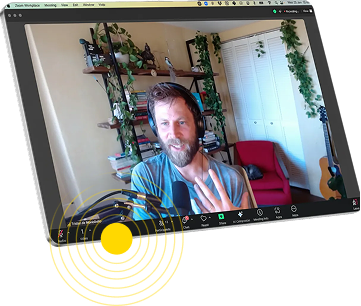
A few weeks ago, Michael gave a coaching session to a room of a hundred people.
A student named Dave raised his hand to talk about his fear of appearing incompetent when giving a presentation at work.
Michael said, “We are not really scared of how other people see us. We’re scared of looking at ourselves and going: oh man, I’m really not the person that I want to be.”
Dave is an executive coach. “When I am facilitating a group discussion or am in a meeting advising a client, I definitely will freeze and contract, and then I’m not able to maintain that state of openness and curiosity needed to excel in my job.”
Michael asked him, “Something is scaring you. What is it?”
Dave’s answer: “It’s being seen. And then the fear of messing it up and revealing my incompetence.”
To which Michael answered, “Underneath the fear of other people’s impressions is a lack of self-acceptance.”
Where the fear actually comes from
You are afraid of their judgment. Michael’s point is about where that fear comes from.
It comes from not being okay with where you’re at.
Their opinion only stings because it might confirm a verdict you already have about yourself.
Get okay with not having the answer to everything, and their judgment loses its grip.
Michael used himself as an example. He’s a white belt in jiu-jitsu.
He pictured his wife in the room, watching him roll with a blue belt, watching him lose.
A white belt should lose to a blue belt. That’s perfectly normal. But he still didn’t want his wife seeing him be the white belt.
As he explained, “Underneath that, it’s like: oh, I am not okay with where I’m at.”
Bringing it back to Dave’s example, he wasn’t okay with stumbling in front of his clients.
A fumble would mean incompetence. So he felt he needed to be fumble-proof to be okay.
Two ways to change your relationship with fumbling
How do you become okay with not being perfect at what you do?
The first approach is to try harder, prepare more, rehearse your answers, build a version of yourself that can’t be caught out.
It might work. Until that one question you didn’t prepare for.
Then you’re back at the start with a longer list of things to control.
The second approach is to change your relationship to fumbling, or whatever it is you’re struggling with. Michael told Dave two ways to do that.
1. Get okay with being human
Michael’s way out of the jiu-jitsu thing was not to get better at jiu-jitsu first.
It was to be okay with being a two-stripe white belt.
“Of course I’m gonna get choked out in jiu-jitsu. Of course there’s a possibility I’m not gonna know what to do. Of course I can stumble, I’m human.”
Then he added the part that does the work: “I’m doing the best I can. I know somebody else in my position could also stumble.”
Those sentences were already true before he said them. He’s just agreeing with them out loud.
Dave is in the same position in a client meeting. So are you.
Of course you might blank. You might fumble. Of course a question comes that you can’t answer.
You’re a person doing a job.
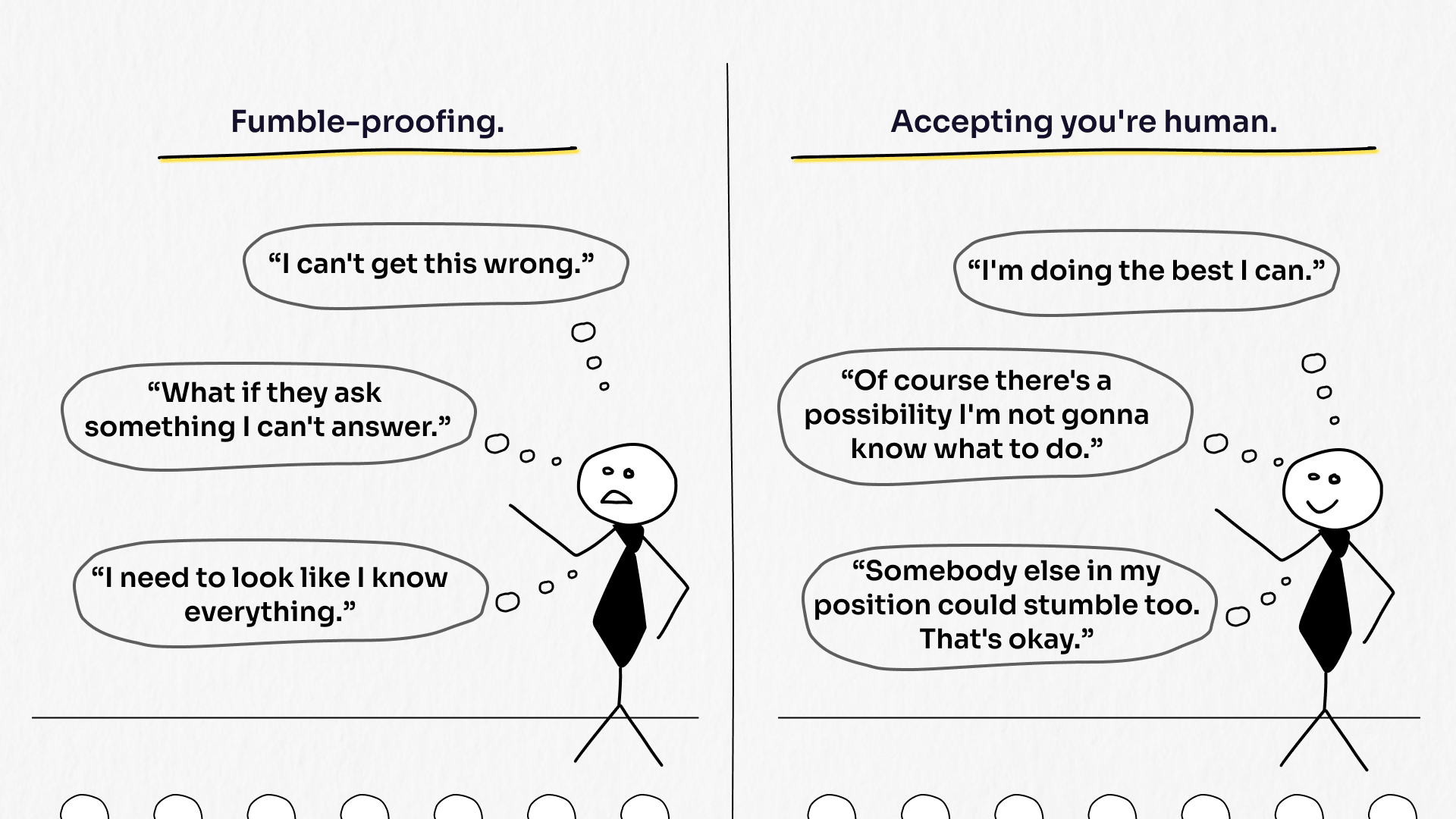
As Michael said, “That true comfort with accepting the human condition will allow the fear to dissipate.”
The fear needs somewhere to stand. Being comfortable with your own imperfection takes the ground out from under it.
And the best part is that when the fear stops taking control, you fumble less.
2. Build a faster bounce-back
Getting okay with imperfection sounds reasonable until money is involved.
Dave raised that right after Michael finished. “But sometimes there are real consequences, if people have trusted me to be competent, and then paid for it.”
Being okay with a stumble is harder when it comes with a price.
He’s not worried about looking silly at a hobby. Dave coaches executives. Clients hire him because they believe he knows what he’s doing.
Michael’s answer: “You do the best you can. You’ll feel pressure. You’ll feel nervous. And you’ll feel disappointed when it doesn’t go well. What happens to people who have been consulting for 50 years? They get better at the craft. But what they also get better at is getting over the fumbles.”
After decades of practice, the fumbles keep coming. But they stop lasting.
A bad session is still a bad session. But they start to affect us less and less.
With your communication skills, you get there by fumbling and recovering in front of people, over and over, in an environment where a fumble doesn’t have consequences.
Our free live class is one of those places. It’s the first step on the journey to becoming okay with your learning process.
As Michael said, “That okayness with the journey is the fundamental root of why we are all here.”
Everyone in the room is on a journey to overcoming their fear of incompetence, blanking, or fumbling. You get live reps, a coach, and a room of professionals working on the same thing.
See upcoming free live classes
Tristan
Common questions about the fear of looking incompetent
Isn’t the answer just to prepare more so I don’t fumble?
That is the fumble-proofing approach, and it works right up to the first question you didn’t prepare for. Then the list of things to control gets longer. The fear was never about the gap in your preparation. It was about not being okay with being seen at the level you are at, and no amount of preparation fixes that.
How do I accept being imperfect when clients are paying me?
You separate the standard for your work from the verdict on yourself. Do the best you can, feel the disappointment when it doesn’t go well, and get better at recovering. The consultants who have done this for fifty years still fumble. What they built is a faster bounce-back, not a fumble-proof version of themselves.
Why does being okay with fumbling make me fumble less?
Because the fear is what was tightening you up. When a stumble can’t confirm a verdict about who you are, your attention goes back to the person in front of you instead of to monitoring yourself. That is the open, curious state you were trying to protect in the first place, and it comes back on its own once it has nothing to defend against.
How do you overcome public speaking anxiety for good?
The honest answer is there may always be situations where you feel a bit nervous before speaking because it matters a lot to you. But your relationship with the nerves completely changes. Most of our students tell us they begin to look forward to these situations or they just don’t feel distracted by them anymore. In Fundamentals, we train you to speak on the spot, and when you fumble in front of two or three people, you discover nobody cares and you’re fine to move on. Do that a few dozen times in five weeks and the nerves about messing up in real life stops feeling like a big deal. If you do it for a year, you will find the nerves will get harder and harder to feel.