I just got off a call with Mark, a student who finished our Professional L1 cohort.
Honestly, I finished the call like this: 🤯
He is a senior engineer at one of the world’s largest tech companies. He leads more than fifty people.
In the last few months, the daily work in Mark’s role has changed.
For most of his career, he had a clear path: code for two or three weeks, write up what he’d built in a doc to send to engineers, then sit down with a customer or a stakeholder.
By the time he had to talk to anyone, the work was already finished, and he had plenty of time to prepare his notes and what he wanted to say.
That worked for years.
Then two things happened at the same time:
First, his manager got promoted, which meant Mark got pulled into bigger projects.
His manager told him, “If you want to keep moving up, you need to learn to talk to stakeholders and execs.”
Mark had never really had to. For years, only engineers read his documents.
Now he has to speak with product leads, execs, VPs and team members he barely knows. A technical document doesn’t cut it.
Second, AI started doing more coding. Work that used to take him 2-3 weeks now takes a couple of hours.
Mark’s talking to people across the company every day, in rooms where he can’t fall back on a written document.
“AI is doing most of the coding work now. What’s left is communication between people. Tomorrow, I’m going to have a conversation with a different group of people. I know what I’m going to say. But I don’t know if I can convey my message clearly.”
That’s why he decided to join Ultraspeaking.
His logic: If AI is handling a big part of his job, he needs to get good at what AI can’t do for him: speaking.
What Mark is going through, honestly, we’re all going through. It’s a kind of metamorphosis:
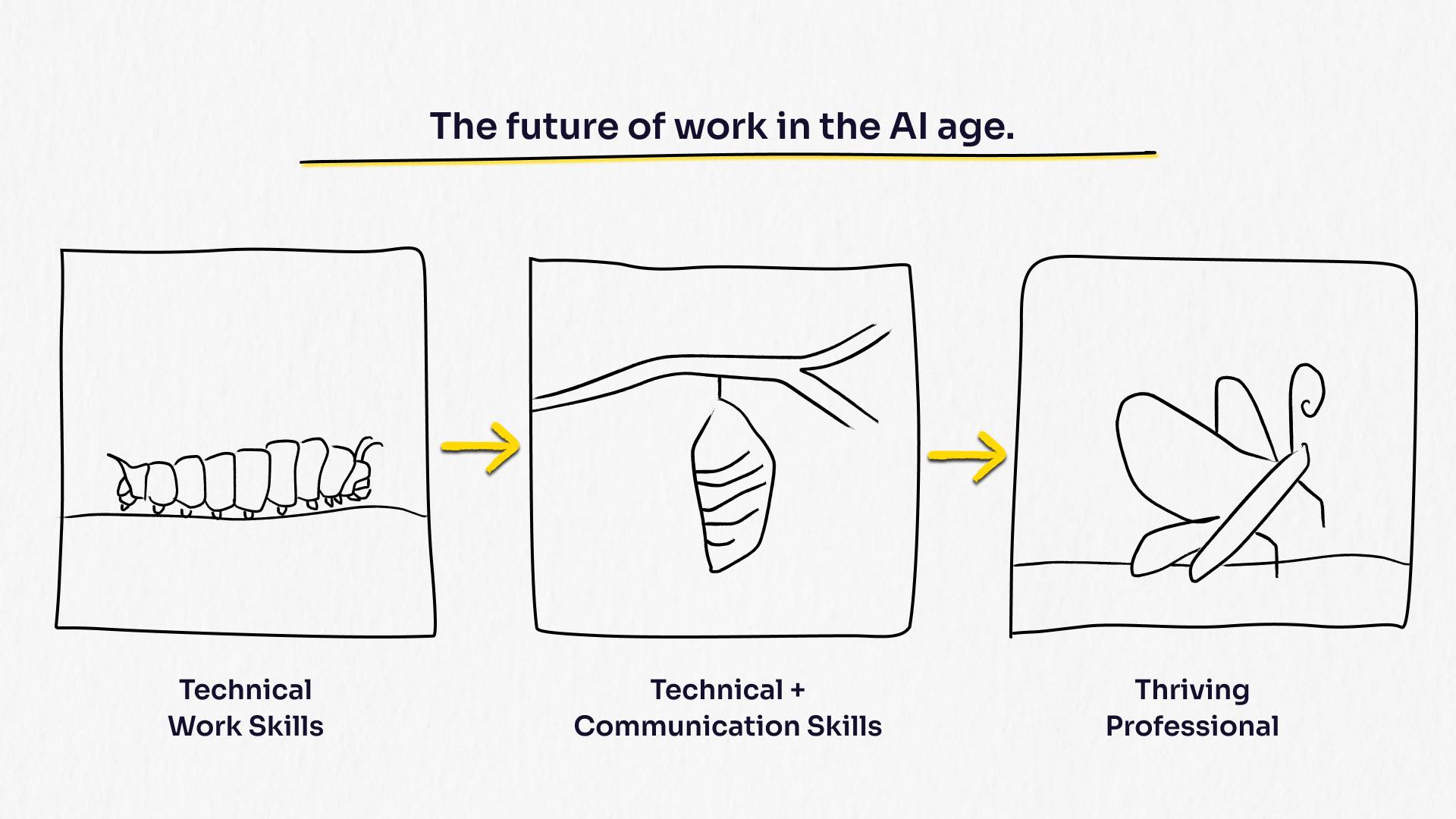
And this transformation can be explained in three stages:
Stage 1: The caterpillar (the skills AI is replacing)
The caterpillar is the engineer Mark was for years.
He went deep into technical work and explained his thinking through long, careful documents to engineers.
But AI is doing more of that work every month, getting better at it, and doing it faster than he could.
Stage 2: The cocoon (where speaking lives)
The cocoon is the uncomfortable middle.
For Mark, it’s working on his communication skills.
He’s being asked to explain his thinking in real time to people who don’t share his engineering background.
Before, talking to engineers felt natural, he was in a “comfortable” territory.
Now, he needs to elevate his communication. Talking to execs and VPs requires a new level of speaking: one where Mark brings high-level thinking rather than the nitty gritty details of engineering.
The work of the cocoon is learning to speak with clarity, so everyone in the room can understand him.
What’s left is the part of the job that’s still human: communicating with people.
Stage 3: The butterfly (the professional who can thrive with AI)
The butterfly is the engineer who can walk into any room with confidence and ease.
This engineer can talk to the executive, the product lead, the customer, the colleague from a team he doesn’t know, like he owns the room.
Mark told me he thinks every senior engineer at every big tech company is about to be where he is now: working on their speaking.
Layoffs are happening across tech, and many companies are flattening their org charts.
That stuck with me, because we can see it happening in other industries too.
We’ve spent years getting good at what we do: building expertise, learning specific skills, and earning the seats we sit in today. And that matters… It’s what got us here.
But AI is doing that work faster and, pretty soon, better than we are.
What’s left is communicating at a master level.
The ability to speak clearly, with confidence, and to actually enjoy talking to people without your head getting in the way.
After my conversation with Mark, it was clear to me:
Speaking skills have gone from being a “nice thing to have” to being a large part of the actual job.
For him, Professional L1 worked so well that he decided to commit to a whole year of our Unlimited Membership. Now, he’s taking more reps, getting more feedback from coaches and other professionals, and bringing what he is learning each day into his workplace.
So, if you’re like Mark, an already successful professional who wants to speak to execs and stakeholders without overthinking, land your ideas clearly in any room, and become the communicator you know you’re capable of being, I’d love for you to join one of our free live classes.
You’ll practice with other people who are eager to step into their cocoon.
Tristan
Common questions about communication skills and AI
Will AI replace communication skills at work?
AI can write the doc, the code, the summary, and even make the deck to present after. It can’t walk into the room, read the faces and answer the VP’s question in real time. That’s what Mark found: once AI cut his coding from weeks to hours, most of his day became talking to people. Your expertise still matters. It’s what earned you the role you are in. But the part of the job that’s left is saying what you think, clearly, to people who don’t share your background.
How do I explain technical work to executives?
Start from the problem it solved and the outcomes, not the context or details. Execs want the outcome, the risk, and what you need from them. The hard part usually isn’t knowing that. It’s that in the moment, your head gets busy and you fall back on the detail you’re comfortable with. So prepare the one thing you want them to leave with, rather than a script. Then practice speaking on the spot to people outside your field, so real time stops feeling like a test.
Is it too late to work on my speaking if I’m already senior?
No. Senior people are exactly who I see doing this work right now. Mark leads more than fifty engineers, and he started because the job changed under him, not because he was bad at it. You already think clearly and you have plenty to say. The work is getting your head out of the way so that thinking comes out in the room. That tends to change faster than people expect, because you’re not building something new. You’re uncovering what’s already there.
How can I practice speaking in real time?
Practice out loud, with other people, without a script. Speaking in real time is a different skill from writing, and rehearsing alone in your head doesn’t build it. In our free live class, you speak on the spot in small groups with people who are working on the same thing. If you’d rather start on your own schedule, the free app has short speaking exercises you can do in a few minutes a day.
Is there a communication course for engineers who present to executives?
Yes, and the best ones have you speak, not watch. Engineers rarely lack the knowledge. Mark knew his work better than anyone in the room. What changes in front of a VP is the pressure. TJ Moretto, the CTO of Babylist, told us: “I used to over-prepare (or under-prepare) and it would give me a ton of anxiety. The coaching, reps, and feedback changed that completely.” Our Professional L1 cohort is 12 live one-hour sessions over four weeks where you practice executive updates, explaining complex work simply and answering questions on the spot, with professionals from other fields.
Which communication course helps with career advancement?
The one that works on the speaking your next role depends on. For most people moving up, that’s updates to leadership, disagreeing in meetings and answering questions you didn’t prepare for, not keynotes. Look for live practice with real people and feedback right after each turn. Sally Le, a senior software engineer at Slack, put it simply: “I finally overcame my fear of speaking up in meetings and voicing my ideas.” Mark’s manager told him that moving up meant talking to stakeholders and execs, and that’s what he practiced in Professional L1.
More related reading
How to calm your nerves before presenting to executives