Have you ever sat in a meeting feeling totally fine right up until it’s your turn to present?
In one of our Q&A sessions, Sara asked about overcoming nervousness in a high-stakes scenario.
She was at an exec meeting to present a deck she had worked on for two months. She felt confident and calm.
But when it was her turn, the nervousness hit, and the symptoms started showing. Her palms got really sweaty, she was speaking at a higher pitch than she normally does, and she was even second-guessing herself.
The worst part, in her opinion, was this: “It was all too distracting.”
She continued, “I had a lot of confidence in the analysis I worked on. And then right as the last person was teeing me up, that’s when the nervousness kicked in.”
She was in the kind of room where someone’s opinion about your work matters a lot.
Michael, my co-founder, asked Sara, “What were you telling yourself about the meeting?”
It turns out, without realizing it, Sara had raised the stakes of that meeting to the point that it triggered a feeling of nervousness she wasn’t prepared to deal with.
At Ultraspeaking, we help you solve this by minimizing the stakes in your head
For Sara, it meant training her mind not to catastrophize the possible outcome of that meeting.
Here’s how it works. Your body responds to what you tell it.
If you walk into a room thinking, “These are important people and my career depends on this. If I make a mistake, I may lose my job,” your nervous system takes that as instructions. It prepares you for a threat that isn’t there with a rush of adrenaline.
Sara felt adrenaline rushing through her body because she had unconsciously told it, “Hey, if you make a mistake, it’s catastrophic.”
And the problem was not that she felt nervous. It was that her relationship to that nervousness was sabotaging her. The feeling is natural. You’ll always have a rush of adrenaline and cortisol in a situation that is high stakes.
Two ways to deal with nervousness
Step 1: Before you walk into the meeting
Ask yourself, “What am I telling myself about this meeting? Am I making it bigger than it is?” An exec meeting is an opportunity to share what you know.
Step 2: When the nervousness shows up anyway
The key is to reinterpret the feeling.
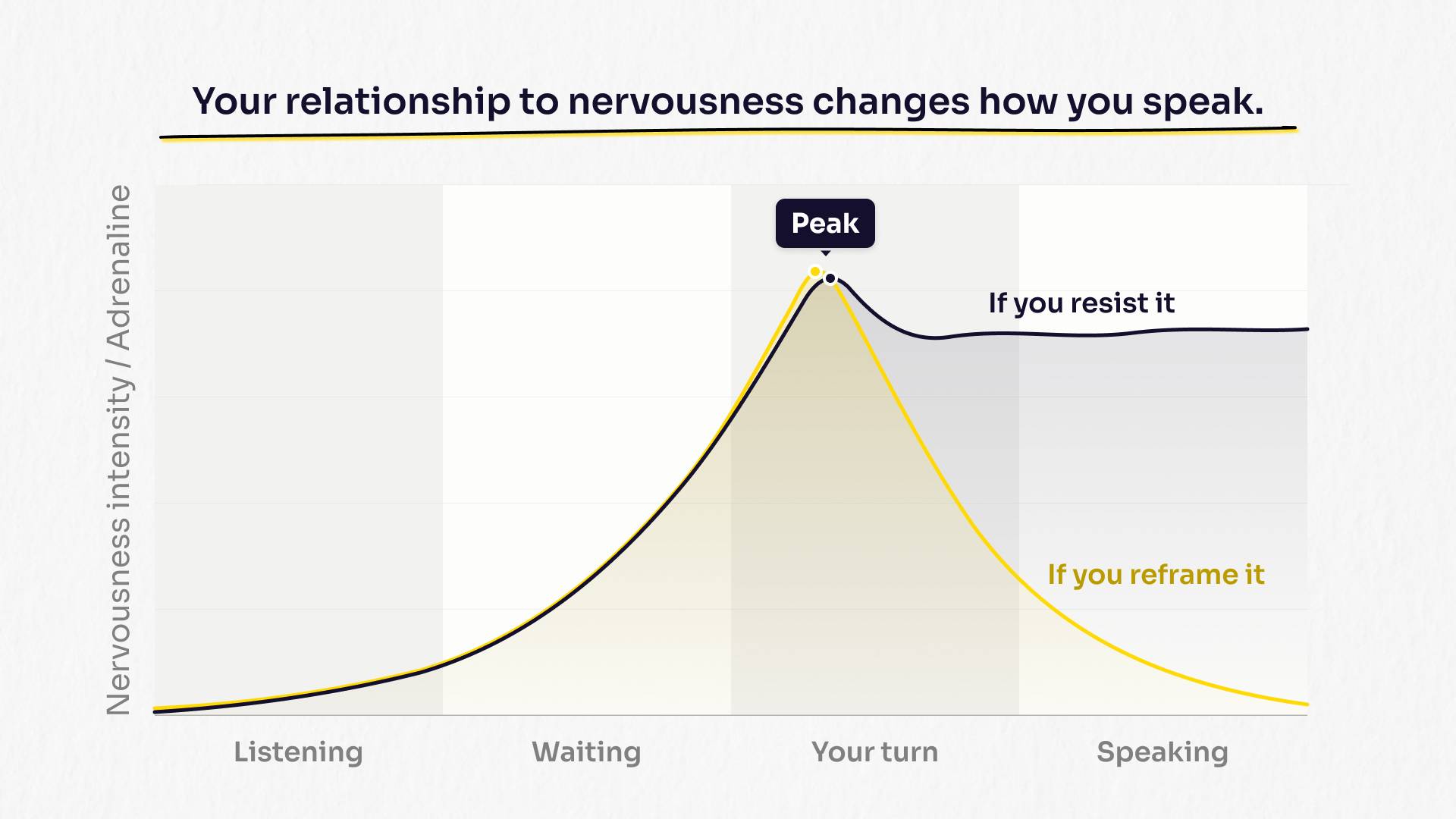
Fighting it doesn’t work in your favor. Thoughts like “Something is wrong,” “I need to calm down,” and “Why is this happening again?” keep the loop going. You feel nervous, you tell yourself it’s a problem, and you get more nervous about being nervous.
When you reinterpret the feeling, it sounds more like “Hey, adrenaline, you’re right on time,” or “My body’s preparing me for something important,” or “I’ve experienced this before. This is how it’s supposed to be.”
Everything in your body starts to calm down once you stop resisting the feeling. The more you try not to feel nervous, the more nervous you’ll feel.
At best, the calm feeling returns. At worst, the adrenaline becomes something that helps you think quicker, rather than a problem.
A challenge for your next high-stakes meeting
Before you walk in, ask yourself one question: What stakes am I adding to this that aren’t actually there?
If you get nervous, tell your body, “Hey, adrenaline, you’re right on time to help me.”
Nervousness will show up anyway. It doesn’t matter if it’s a once-in-a-lifetime meeting or a routine one. What matters is how you process it.
Here’s a reframe Michael shared with Sara. Think of nervousness like an athlete before a competition.
The first time, the adrenaline is overwhelming. Everything feels unfamiliar and scary.
The fifth time, the adrenaline is still there. But they’ve been there four times before. It’s less scary.
By the ninth time, the physical sensations are almost identical to the first competition. But they can identify and reframe them.
The nervousness doesn’t go away completely. But it won’t peak as much, and they stop treating it like a problem.
So next time you go into an executive meeting, reframe the nervousness peak to “Right on time. My body is preparing me for something important.”
The fastest way to get those reps is to feel the adrenaline in a room where nothing is at stake. Our free live classes put you on the spot in front of other people, with a coach who gives you feedback in the moment.
See upcoming free live classes
Tristan
Common questions about presenting to executives
Is it a bad sign that I still get nervous after years of presenting?
No. The adrenaline shows up for the athlete on their ninth competition too. The feeling is not the problem, and it is not evidence that you are bad at this. The only thing that changes with experience is your relationship to the feeling. You learn to read it as your body getting ready, not as a warning.
Should I just prepare more so I feel less nervous?
Sara had worked on her deck for two months, and the nerves still arrived on cue. More rehearsal polishes the words, but the nerves don’t come from the words. They come from the story you’re telling yourself about the meeting. Prepare that instead. Decide who you want to be in the room and what you want them to walk away with, and let the words organize themselves around it.
What if I try the reframe and I’m still shaky?
Shaky is allowed. The goal was never to feel nothing. It is to keep going while you feel it. People can’t see what’s happening inside you, only you can. Every time you present with the adrenaline present and nothing bad happens, your body learns that the room is safer than it felt, and the next peak is a little lower.
What’s the best course for presentation anxiety?
The best course for presentation anxiety makes you speak under pressure, with someone watching, and then do it again. The stakes should feel high, but are completely ok to experiment and mess up in a supportive environment. Watching videos about anxiety won’t do the trick. In our Fundamentals L1 cohort you spend most of each hour in a breakout room of two or three people with a coach, playing speaking games you can’t prepare for. The nerves show up, you speak anyway, and you learn that it came across much better than you thought it would. The free Day 1 of Fundamentals class is the exact format for the course, in one hour. You can experience what it’s like.
I’m a nervous speaker. Which kind of course actually helps?
Avoid anything that promises to remove the nerves after one video or one course. You need a lot of practice feeling it and speaking anyway, in a space where nothing is at stake. Look for live practice with real people, feedback after every turn, and a group small enough that you don’t get too nervous on day 1. That is why Fundamentals is built around two-to-three-person breakout rooms with a coach, three times a week. Toastmasters gives you one speech at a meeting (at most). A private coach gives you one listener.